
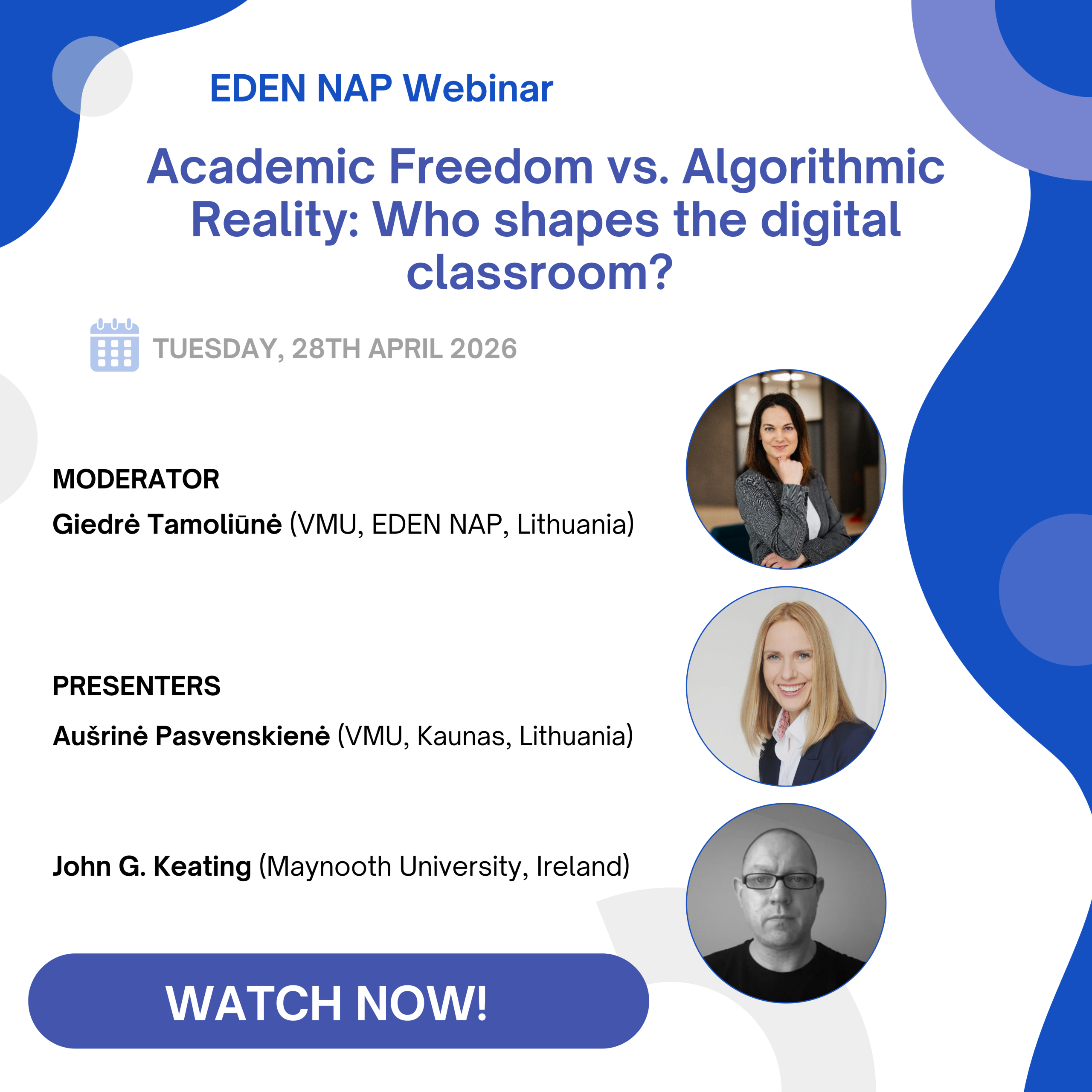
Watch EDEN NAP Webinar – Academic Freedom vs. Algorithmic Reality: Who shapes the digital classroom?, April 28, 2026
Academic Freedom vs. Algorithmic Reality: Who shapes the digital classroom?
Whose freedom is it anyway? As AI moves from the sidelines to the centre of higher education, we face a new “algorithmic reality.” This webinar explores whether the digital tools we use to teach and research are silently standardizing the very art of academic inquiry. We will seek to take a look at the tension between high-tech innovation and the fundamental right to maintain a unique, independent academic voice.
The session features a dual-perspective dialogue: assoc. prof. Aušrinė Pasvenskienė (Vytautas Magnus University, Lithuania) will address the legal and ethical safeguards needed to protect scholars in a digitalised world, while prof. John G. Keating (Maynooth University, Ireland) will explore how the design of our digital environments—from AI assistants to collaborative platforms—shapes our discourse and limits or expands our pedagogical autonomy. Join us for this presentation and discussion to discover how we can harness technology without letting algorithms replace our own pedagogical decisions.
Moderator
Dr. Giedrė Tamoliūnė is an associate professor at Education Academy and senior specialist at the Institute for Study Innovations at Vytautas Magnus University. She is involved in European and national scientific and applied projects focusing on technology-enhanced teaching and learning aspects. Her research interests focus on technology-enhanced teaching and learning in higher education, digitally competent educators and institutions, the cooperation between EdTech and educational institutions, AI in education, and adult education. She has been a Steering Committee member of the EDEN Network of Academics and Professionals (NAP) since 2023.
Presenters
Aušrinė Pasvenskienė is an assoc. prof., vice dean at the Faculty of Law, Vytautas Magnus University (VMU, Kaunas, Lithuania), a researcher at Vytautas Kavolis Transdisciplinary Research Institute (VMU); a chair of VMU ethics committee; a visiting researcher at the Faculty of Law, Helsinki University (Finland). She serves as the Editor-in-Chief of the Baltic Journal of Law and Politics, is the Principal Investigator for the Erasmus+ project “Modernization of Legal Education for the Support of European and Euro-Atlantic Integration of Ukraine” (EU4UA), is a member of the European Association of Education Law and Policy. Her research interests include education law, human rights in education, the intersection of law and digital technologies, also law, education and digital technologies.
John G. Keating is Professor of Computer Science at Maynooth University, where he serves as Associate Dean for Teaching and Learning in the Faculty of Science and Engineering. A mathematician and computational scientist by training — with a BSc in Mathematics and Physics, a PhD in Atmospheric Physics, and postgraduate qualifications in science education and applied linguistics — he brings an unusually cross-disciplinary perspective to questions of technology and pedagogy.
John’s current research sits at the intersection of artificial intelligence, higher education practice, and curriculum quality. He leads an active programme investigating AI-assisted coding, automated analysis of learning outcomes at national scale, and the linguistic dimensions of human-AI interaction in educational settings. Within Maynooth, he is a leading institutional voice on AI in higher education, regularly advising on policy, ethics, and pedagogical design.
His particular interest for this panel lies in how the architecture of digital tools — from AI coding assistants to learning management systems — encodes assumptions about knowledge, inquiry, and academic voice, often invisibly. He argues that pedagogical autonomy in the AI era requires not just policy protection but genuine digital and curricular literacy: the capacity to interrogate the tools we use, not merely deploy them.