
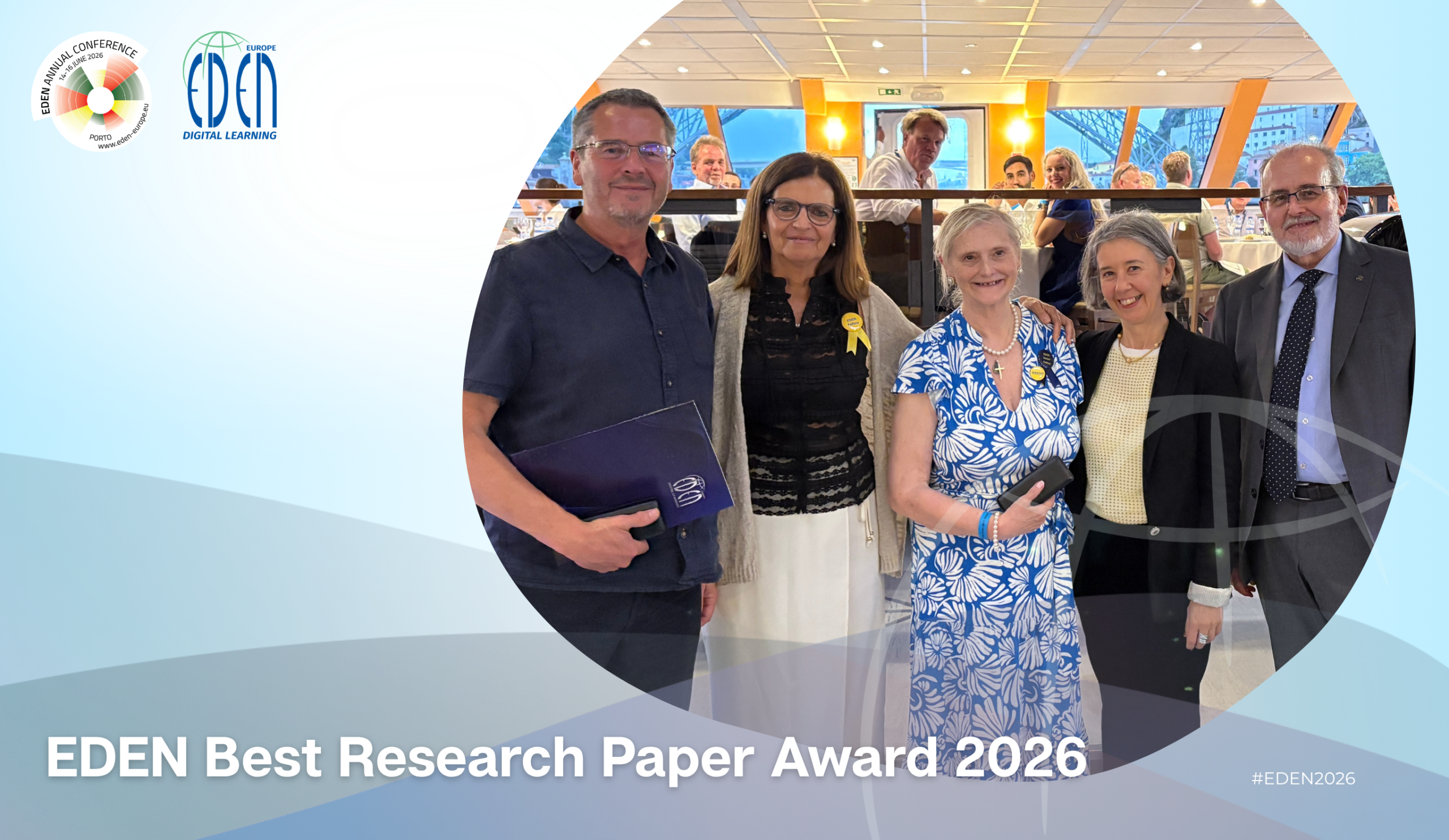
EDEN Best Research Paper Award granted at the 2026 Annual EDEN Conference Porto, Portugal, 14-16 June 2026
Since 2008, EDEN Digital Learning Europe has presented the Best Research Paper Award at its Annual Conferences and biennial Research Workshops. A high quality standard selection process guarantees the branding of a distinguished and reputable award for scholarly conference papers in the field of open, distance and e-learning.
The selection process is supported by the UNESCO Chair in Education & Technology for Social Change at UOC, and takes place by a Jury, approved by the EDEN DLE Management Board. This year’s Jury members were:
Teresa Romeu (Chair of the Jury), Associate Professor of Digital Education in the Education Department at UOC. She teaches in the Master Programme of Education & ICT and the Postgraduate Programme of Leadership and Management of Educational Institutions. A Researcher in the Edul@b Research Group, her work focuses on Online collaborative teaching and learning as well as digital competence for academics and professionals. She is also a Research Associate of the UNESCO Chair in Education & Technology for Social Change at UOC.
Amélia Veiga, Associate professor at the Faculty of Psychology and Education Sciences of University of Porto (FPCEUP), researcher at the Centre for Research and Intervention in Education (CIIE) and collaborator at the Centre for Research in Higher Education Policies (CIPES). Her research focuses on education policy, analysis, governances in higher education, European integration, internationalisation, globalisation, and quality assurance. Since 2019, she has coordinated the Strategic Research Area on Higher Education, Innovation and Diversity at CIIE.
Ilona Buchem, Professor for Media and Communication at Beuth University of Applied Sciences in Berlin. Her research and teaching focus on the relationship between digital media and society, with particular attention to emerging technologies such social, mobile, wearable and smart technologies. Her research interests include Digital Collaboration, Digital Diversity, Digital Learning and Digital Leadership. She is the Chair of the Special Interest Group on Wearable Technology Enhanced Learning at the European Association of Technology Enhanced Learning (EATEL).
After a first pre-selection, there are five finalist papers, which are, in alphabetical order:
“Before the First Prompt: Understanding Students’ Pre-Use Perceptions of an AI Digital Assistant in Higher Education”, by Chris Edwards, Denise Whitelock, Felipe Tessarolo, Duygu Bektik, Emily Coughlan, Christothea Herodotou & Thomas Ullmann, Institute of Educational Technology, The Open University, UK
“Co-Creating Open Learning Materials for the Digitalisation of Energy: A Collaborative Model for Public and Expert Engagement”, by Denise Whitelock, Irina Rets, Beck Pitt, Chris Edwards, Leigh-Anne Perryman, Institute of Educational Technology, The Open University, UK
“Extending the Invitation: Student Readiness to Engage AI as a Tool or Teammate”, by Danielle Ramirez, Caroline Sanz-Veitch & Patcharin Chen, Monash University, AUSTRALIA
“From Screen to Leaf: Preschool Teachers and the 2025 Digital Rollback”, by Davoud Masoumi & Maryam Bourbour, Department of Educational Sciences, University of Gävle, SWEDEN
“When organizations believe they are digital: An analysis of maturity overestimation among professionals in continuing education”, by Siw M. Fosstenløkken, Akif Quddus Khan & Baifan Zhou, Department of Computer Science, Oslo Metropolitan University, NORWAY
Laudatio
After careful evaluation of all submissions to the Conference, the Jury unanimously decided to award this distinction to the paper entitled:
“Before the First Prompt: Understanding Students’ Pre-Use Perceptions of an AI Digital Assistant in Higher Education”, written by Chris Edwards, Denise Whitelock, Felipe Tessarolo, Duygu Bektik, Emily Coughlan, Christothea Herodotou & Thomas Ullmann, from the Institute of Educational Technology, The Open University, UK.
The Jury recognises this as a highly structured and timely contribution addressing an emerging issue in Higher Education: students’ perceptions of institutional AI assistants prior to first use. The study is clearly grounded in well-defined research questions and demonstrates strong conceptual coherence.
Methodologically, the work is robust and well executed, combining quantitative and qualitative approaches in a coherent mixed-methods design. The integration of cluster analysis with qualitative interpretation enables the identification of meaningful learner profiles.
The findings are clearly presented and offer valuable insights for both research and practice, particularly in showing how behavioural and attitudinal data can inform the design of more inclusive and personalised AI systems in Higher Education.
The paper aligns strongly with the theme of EDEN 2026, “Beyond Technology: Human-AI Collaboration for Learning and Teaching”, especially within the strand Student Agency and Engagement. It provides a nuanced understanding of students’ pre-adoption perceptions of AI and their implications for institutional practice.
We congratulate the authors on this outstanding achievement.