
EDEN Award for Innovation in Digital Education
EDEN Annual Conference • Porto, June 2026
First Edition — 2026
It is with great pleasure that EDEN Digital Learning Europe presents, for the first time, the EDEN Award for Innovation in Digital Education — a recognition established to celebrate outstanding institutional achievements that advance digital learning through innovation, quality, inclusiveness, and evidence-informed practice.
This inaugural award drew 12 nominations, and the jury — comprising Josep M. Duart, EDEN Management Board member and former EDEN President; Elena Trepule, EDEN Secretary General; Fiona Aiken, Chair of the EDEN NAP Steering Committee; and Vlad Mihaescu, Management Board member and Vice President for Membership and Communication — had the privilege of evaluating initiatives of remarkable depth and ambition.
After careful deliberation, the jury unanimously selected a research and innovation initiative that exemplifies everything this award was designed to celebrate.
The winning initiative addresses one of the most enduring challenges in digital education: how to transform Self-Regulated Learning — long recognised as essential for lifelong, autonomous learning — from an abstract theoretical construct into a scalable, teachable, and measurable classroom practice.
Over the period 2023 to 2025, the team developed and implemented a holistic, technology-enhanced approach to SRL, progressing through successive stages of innovation. They began with structured, interactive video-based learning environments that made explicit cognitive and motivational strategies visible and actionable for learners. They then advanced to Generative AI-supported chatbot systems — such as the motivational “Moti Bot” — that scaffold reflection, decision-making, and persistence regulation in real time. Most recently, the initiative evolved into personalised, adaptive professional development pathways for educators, using AI and real-time data to enable context-responsive growth at scale.
What makes this work especially compelling is its deliberate human-centred philosophy: throughout every stage, AI acts as a partner in learning — supporting, not replacing, the human learner.
The initiative reached over 2,000 participants across diverse educational settings, including students, pre-service teachers, and educators in professional development programmes. Evidence of impact is robust: experimental and quasi-experimental studies demonstrate measurable improvements in academic achievement, motivational regulation, cognitive strategy use, and pedagogical design by educators. The work has been published and presented extensively, including across multiple editions of the EDEN Annual Conference, and has contributed to national-level advisory work on responsible AI integration in education.
The approach is explicitly designed to be generic, discipline-independent, and transferable — applicable equally in STEM and non-STEM contexts, and structured to be adopted incrementally by any institution without requiring major systemic change. Its relevance beyond local boundaries is demonstrated by its ongoing integration into Horizon Europe and Erasmus+ programmes, as well as active international collaboration within the EDEN community.
The initiative promotes inclusiveness through bilingual and open-access digital tools. It upholds ethical digital education by keeping human agency at the centre. And it advances lifelong learning by equipping both learners and educators with transferable self-regulation competencies that serve them far beyond any single course or context.
Two individuals stand behind this work — both long-standing, valued members of the EDEN community, and one of them a proud EDEN Fellow. They have contributed not only to this initiative, but to the fabric of EDEN’s scholarly and practitioner community across many years.
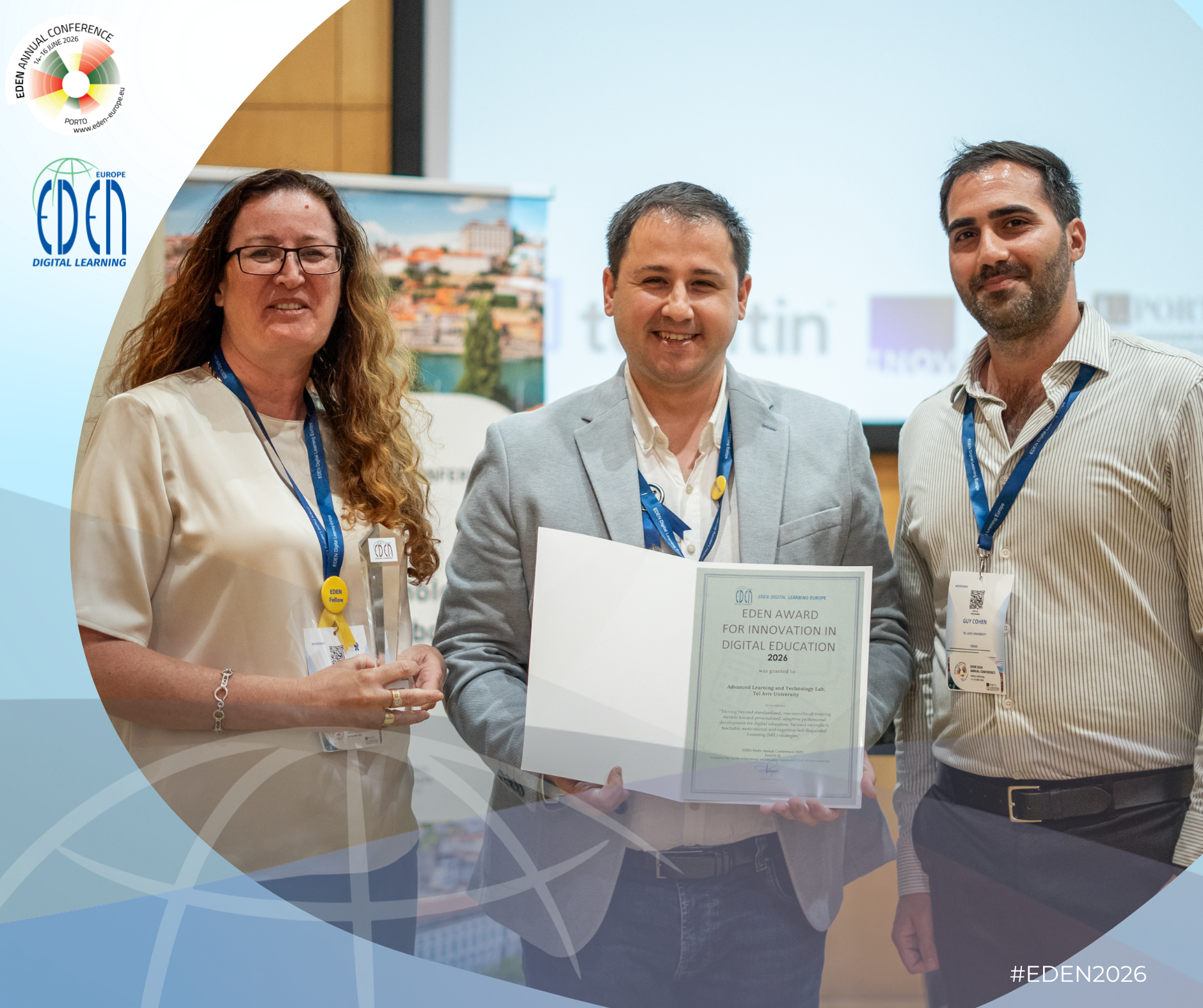
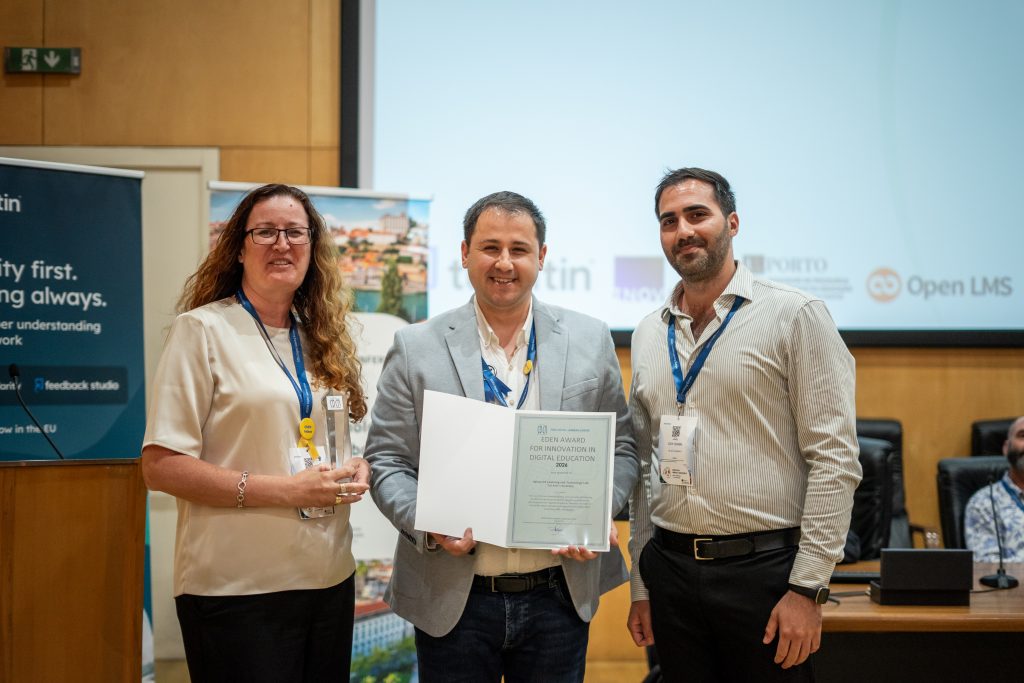
The EDEN Award for Innovation in Digital Education is presented to the
Advanced Learning and Technology Lab
represented by Anat Cohen and Guy Cohen (Tel Aviv University)
Congratulations!