
EDEH conference “Collaborate for Impact”
(Brussels, June 18, 2026)
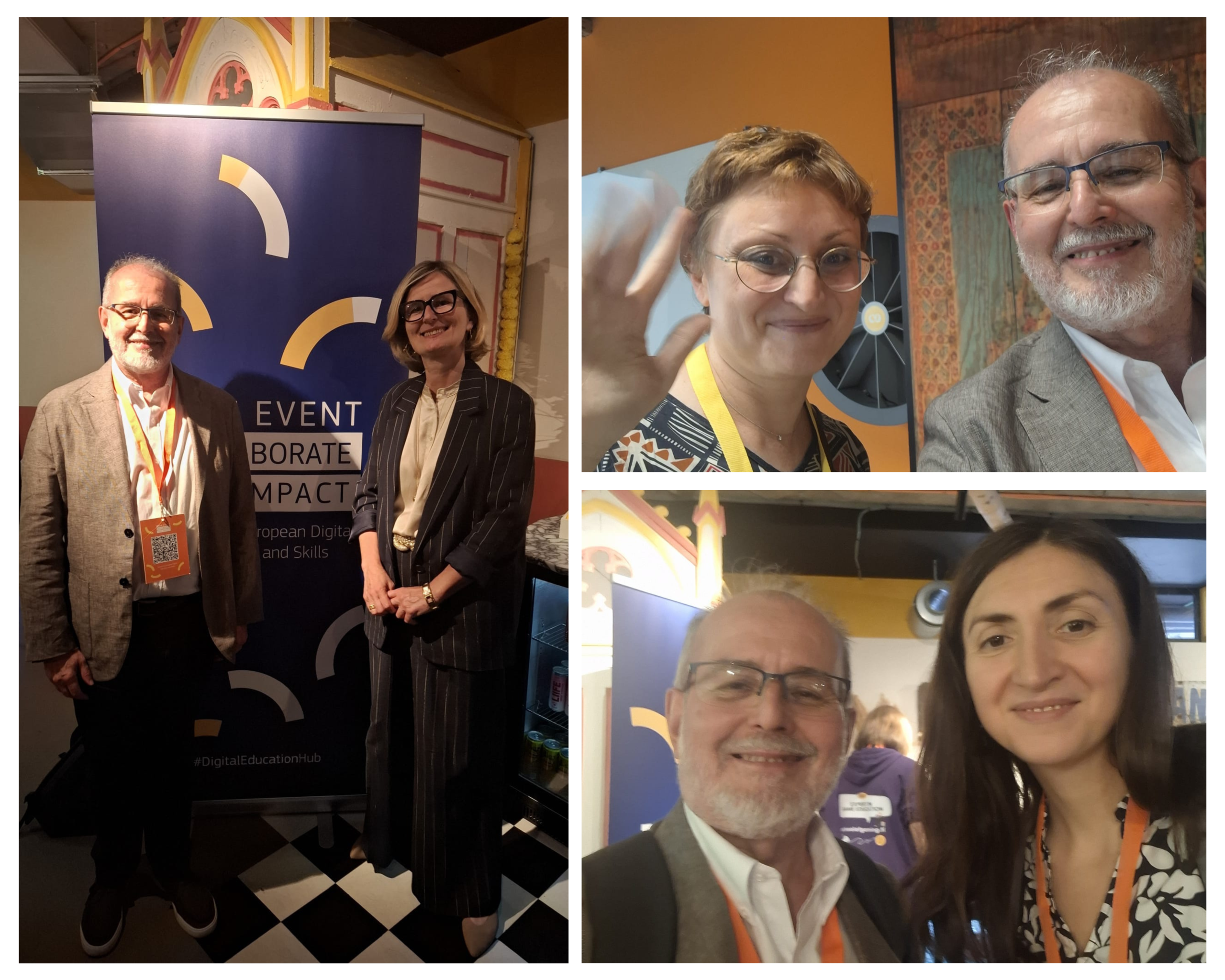
As an active member of the European Digital Education Hub (EDEH) since its launch, EDEN Digital Learning Europe was once again at the heart of the European dialogue on digital education. Representing EDEN, Professor Albert Sangrà, EDEN Vice-President for Strategic Thinking and Networking, joined policymakers, researchers and education leaders to shape the next steps in AI literacy and the future of learning in Europe.
The event opened with a keynote by Roxana Mînzatu, Executive Vice-President of the European Commission for Social Rights and Skills, Quality Jobs and Preparedness, who underlined that Europe’s AI ambitions must be firmly rooted in people. Her central message resonated throughout the day: “The more technology we deploy, the more humanity we need.” She also stressed that achieving digital sovereignty remains a major European challenge, noting that “for the European Commission, AI is not European.”
Looking ahead, Mînzatu announced that the European Commission will launch a new Education Package in November, building on the AI Literacy Framework with practical guidance for implementation across schools. The package will promote AI as a cross-cutting element of education, supported by teacher training initiatives and a renewed focus on basic and digital skills. Emphasis will be placed on citizenship, critical thinking, and preparing primary and secondary education systems to equip learners to navigate an AI-powered world responsibly.
Lidija Kralj, one of the experts behind the new AI Literacy Framework, presented its key features and guiding principles. She explained that the framework is designed for a broad range of education stakeholders, with ethics embedded as a cross-cutting priority and each competence described across three levels of proficiency. Above all, she stressed that the framework has been developed with teachers at its core: “You always have to have a teacher in the conversation.” More information and the full framework are available at https://ailiteracyframework.org/.
The event concluded with a lively panel discussion on the future of AI in education. Pia Ahrenkilde-Hansen, Director-General of DG EAC, encouraged participants to see AI as “a way of creating opportunities while remaining human,” emphasising that young people need both AI skills and a critical mindset. František Ružička from the OECD observed that AI is transforming society at an unprecedented speed, predicting that “today AI is a tool; in three years it will become a teammate.” The discussion also highlighted the importance of computational and critical thinking, the Cypriot Presidency’s commitment to advancing AI in schools, and the need to ensure that AI is designed with teachers, not for teachers.
At the end of the debate, the DG insisted in something that was repeated along the day: the humanist approach, the importance of humans in the development of AI. She said that in 2027, EU will publish a “human capital” recommendation. She ended by saying that she advocates for an ethical integration of AI in education: until now, it has been about the What. In the next years, it must be about the How or the Hows (the implementation).
Discussions highlighted the European Commission’s forthcoming Education Package, expected in November as a follow-up to the Digital Education Action Plan review. Presented by Francesca Maltauro, Deputy Head of the Digital Education Unit, the initiative recognises education as a strategic response to today’s geopolitical challenges, strengthening Europe’s resilience, technological sovereignty, and human capital.
Interactive discussions explored three key themes shaping the future of digital education. Participants emphasised that digital sovereignty is not only about secure technologies and data protection but also about creating a European ecosystem built on shared values, trust, and educator involvement in designing digital solutions. The AI in Education discussions reinforced that teachers remain at the heart of successful transformation, requiring modern curricula, new approaches to assessment, high-quality AI tools, and continuous professional development. Meanwhile, the Digital Literacy and Well-being group stressed that well-being must become an integral part of education policy, supporting educators, adult learners, and seniors while fostering more inclusive and sustainable learning environments. Francesca Maltauro closed the event: shared purpose. Improve digital education. Making it relevant and impactful for the community. And the message of the day: HUMAN SOCIETY.